 1 / 6
1 / 6Metallic finishes
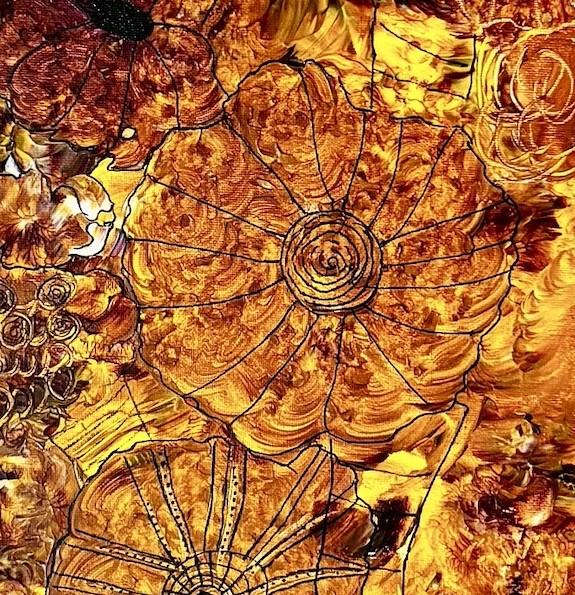
Gold is built up thickly enough to hold a mark, then drawn into while the surface is still open.
Detail — All That Glitters
In the studio
Every layer holds a memory. Every pattern carries a connection. Every texture invites a closer look.
A Patricia Brackett painting is a built object. It has depth you can see across a room and depth you can only find by standing close to it.
Photographs flatten that. What a screen cannot show you is that the gold sits proud of the canvas, that the dots along a petal edge are physically raised, that a line of black has enough body to throw a shadow. The details below are the closest a screen can get.
The work up close
Every layer holds a memory. Every pattern carries a connection. Every texture invites a closer look.
1 / 6Gold is built up thickly enough to hold a mark, then drawn into while the surface is still open.
Detail — All That Glitters
 2 / 6
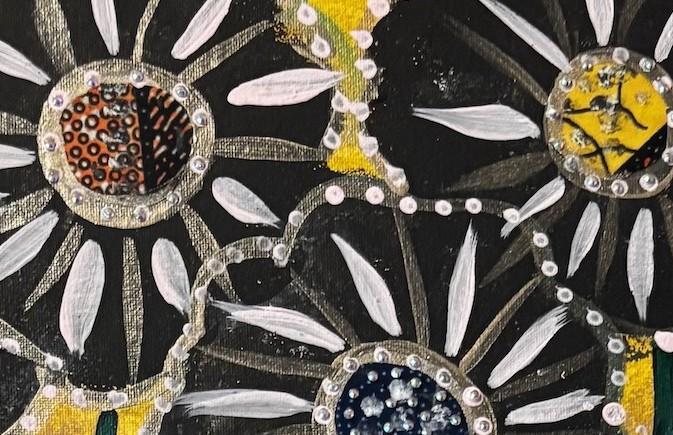
2 / 6Beads and small raised elements are set into the surface, so the edge of a petal is something you can feel.
Detail — Night Garden
 3 / 6
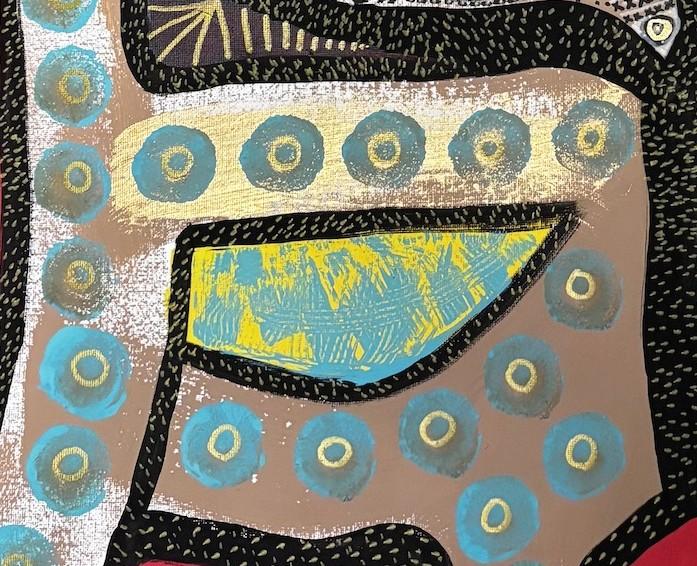
3 / 6Dots are laid in runs by hand. No two are the same size, and the drift between them is what gives a field its pulse.
Detail — Rhythm on Red
 4 / 6
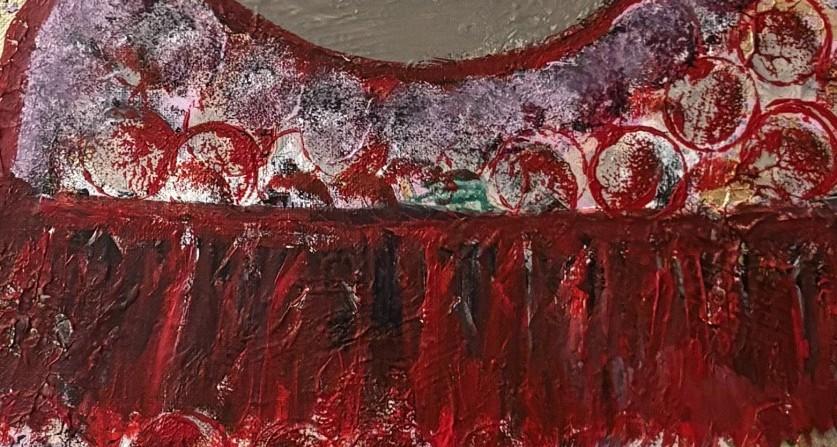
4 / 6Colour is worked wet into dry over and over, so what reads as one red is four or five reds deep.
Detail — Woman in the Red Headwrap
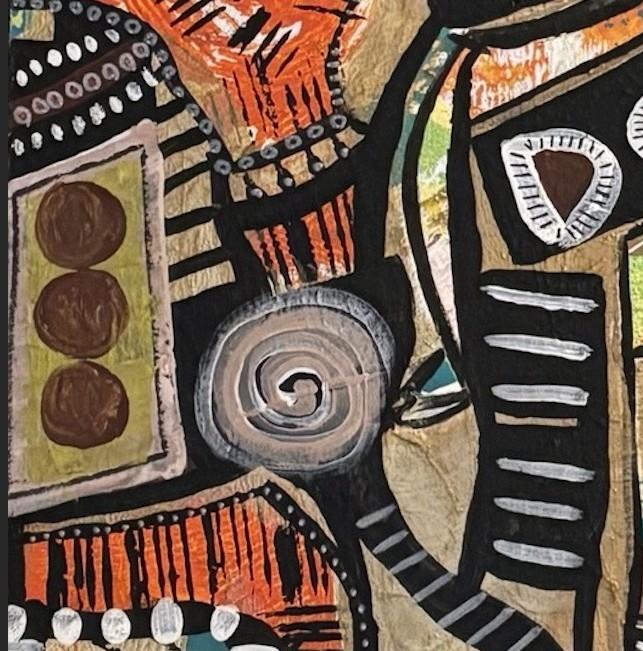 5 / 6
5 / 6A heavy black contour holds each field apart, then a run of white dashes softens the boundary again.
Detail — SHO-NUFF
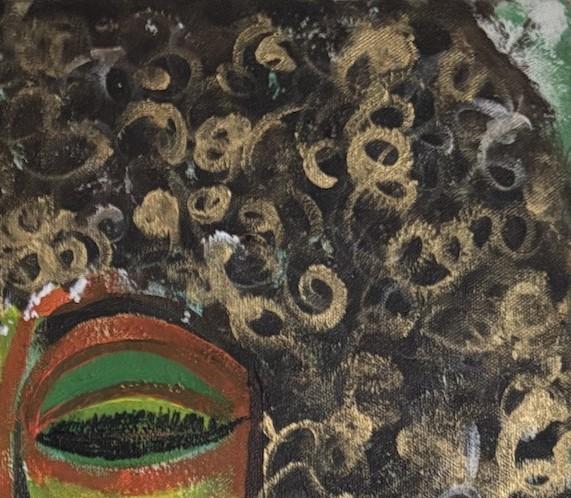 6 / 6
6 / 6One spiral, then a hundred. The repetition is where the meditation of the work lives.
Detail — Crown of Spirals
The layers
The ground and the body of the work. Colour is laid in broadly, then worked over: wet into dry, opaque over transparent, until what reads as a single field is four or five decisions deep.
Patterned cloth is set into the surface, so a garment in a painting can be built from something that was genuinely woven rather than described with a brush.
Paint is left thick where it should be felt. Impasto passages hold the mark of the tool that made them and change as the light in the room changes.
Dots, dashes, crosshatch, chevrons, spirals. Applied in runs by hand, so the drift between them — never mechanical, never identical — becomes the rhythm of the piece.
Beads and small raised elements are set into the surface, catching light along an edge and asking you to come closer than a flat painting would.
Gold appears as leaf and as heavy metallic paint, worked into rather than laid over. It is a ground in its own right, not a highlight.
Materials that arrive with a history of their own are brought into the work, which is part of how a painting ends up holding memory rather than depicting it.
Very little is planned. A mark is made and then answered; the painting is arrived at through the making of it rather than executed from a sketch.